Source and Receiving State Definition Geography
The place where a river begins is called its source. River sources are also called headwaters. Rivers often get their water from many tributaries, or smaller streams, that join together. The tributary that started the farthest distance from the river's end would be considered the source, or headwaters. Many rivers, including the Rhone in Western Europe, begin as streams in mountains or hills. As ice and snow melt, streams begin to flow downward from high mountains and the bases of glaciers. When a glacier is a river's source, the river has glacial headwaters. The Ganges River has glacial headwaters. The source of the Ganges, in India and Bangladesh, is the Gangotri Glacier in the Himalayas of northern India. Springs are the sources of some rivers. A spring is a place where water in the Earth, called groundwater, flows to the surface naturally. A spring forms when an aquifer, or natural underground reservoir, fills with groundwater and overflows. The spring of the Breg River, in Germany's Black Forest, is the source of the Danube. Lakes with outflowing streams can become the headwaters of rivers, but only if they do not have streams that flow into them. (The inflowing stream—not the lake—would be a source of the river.) The Mississippi River, the largest river in North America, starts as a stream from Lake Itasca, a glacial lake in the U.S. state of Minnesota.
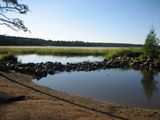
In the 1930s, the Civilian Conservation Corps (CCC) modified the channel of the Mississippi as it emerges from Lake Itasca.
Photograph by Ryan Hanson, MyShot
Get to the Source
Finding the source of the Nile River was a major exploration goal in the 19th century. The Nile has two major tributaries, the White Nile and the Blue Nile. The Blue Nile's source is Lake Tana, Ethiopia.
The source of the White Nile is more difficult to find. Lake Victoria is often cited as the source, but Lake Victoria has many tributaries. The furthest documented tributary to Lake Victoria, and therefore the White Nile, is the high-altitude rain forest in Nyungwe Forest, Rwanda.
Noun
an underground layer of rock or earth which holds groundwater.
exploration
Noun
study and investigation of unknown places, concepts, or issues.
glacial headwaters
Noun
river's source that comes from glacial runoff.
glacial lake
Noun
body of water created by a melting glacier.
Noun
mass of ice that moves slowly over land.
Noun
water found in an aquifer.
headwater
Noun
source of a river.
Noun
land that rises above its surroundings and has a rounded summit, usually less than 300 meters (1,000 feet).
Noun
water in its solid form.
Noun
body of water surrounded by land.
mountain
Noun
landmass that forms as tectonic plates interact with each other.
Noun
area of tall, mostly evergreen trees and a high amount of rainfall.
Noun
natural or man-made lake.
Noun
large stream of flowing fresh water.
snow
Noun
precipitation made of ice crystals.
Noun
beginning of a stream, river, or other flow of water.
spring
Noun
small flow of water flowing naturally from an underground water source.
Noun
body of flowing water.
Noun
stream that feeds, or flows, into a larger stream.
Source and Receiving State Definition Geography
Source: https://www.nationalgeographic.org/encyclopedia/source/
0 Response to "Source and Receiving State Definition Geography"
Post a Comment