Effect of Baby Talking to Baby Development a Systematic Review
(CNN)"Goo goo ga ga? Are wu my widdle infant?" If your idea of "baby talk" makes y'all throw upwards in your mouth a little, then it's time to get educated.
True baby talk, which a new study shows can boost infant brain and speech development, is actually proper adult speech, just delivered in a different cadency.
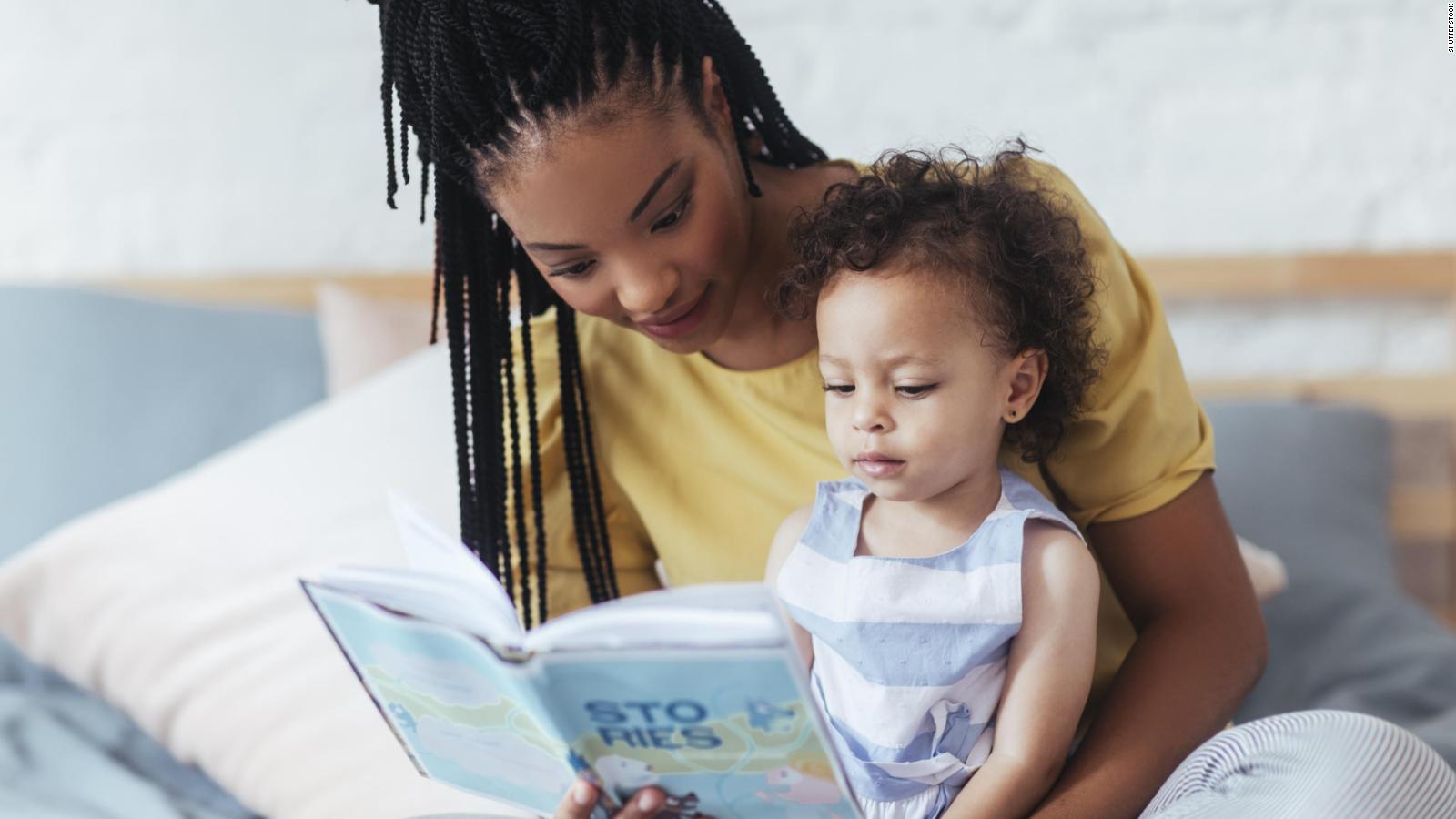
"It uses real words and right grammar, but it does utilise a higher pitch, a slower tempo and an exaggerated intonation," said Naja Ferjan Ramirez, an banana professor at the department of linguistics at the Academy of Washington.
"What people think of as baby talk is a combination of empty-headed sounds and words, sometimes with incorrect grammar," Ferjan Ramirez explained, "like 'Oooh, your shozie wozies on your widdle feets.' "
'Not just listening but talking'
A parenting speaking way that is used in virtually every linguistic communication in the world, true "baby talk" became known equally "motherese" and today is called "parentese" -- because, subsequently all, it's not only moms who utilise it. Many dads, grandparents, older siblings, aunts, uncles and babysitters speak parentese, intuitively aware that it helps the baby tune in socially and respond, even if only through babbling.
"Parentese has 3 characteristics," said Patricia Kuhl, the co-managing director of the Plant for Learning & Brain Sciences at the Academy of Washington, who has been studying children's early on language learning for decades.
"One of them is that information technology has a higher overall pitch, about an octave higher," Kuhl said. "Another is that intonation contours are very curvy; the highs are college, the lows are lower, and information technology sounds excited and happy.

"And then it's slower, with pauses between phrases to give the babe time to participate in this social interaction," Kuhl said.
As information technology turns out, encouraging the "social encephalon" is primal to boosting a baby's speech communication and language development, said Kuhl, an internationally known pioneer in the use of brain imaging.
And babies instinctively prefer it -- as if they are wired to respond. Perchance they are.
Kuhl shared a video from an older experiment starring seven-calendar month-quondam "Paul" to illustrate a baby's preference for parentese.
In the black and white video, Paul sits on his female parent's lap in an enclosed space. On Paul's left side, out of site behind a wall, a woman speaks eight seconds of parentese. On his correct, a woman speaks in a normal adult tone. Paul samples both, then consistently prefers the phonation speaking parentese.
Kuhl'south lab has done studies which show when infants mind to speech, "not only does the auditory cortex area in their encephalon light up, but the motor areas that volition eventually speak lite up," she said, showing the infant is getting ready to talk dorsum.
"The more parents naturally use parentese in their homes when speaking to their children, the improve and faster those linguistic communication skills develop," Kuhl said. "So, it turns out that parentese is a social catalyst for language. It gets kids non just listening merely talking."
Tin can you boost parentese with coaching?
In 2018, Kuhl and Ferjan Ramirez published a written report that showed when parents were coached in parentese, their babies babbled more and had more than words by 14 months than those who were not trained.
In a new study published Monday in the Proceedings of the National Academy of Sciences, the team reports on speech development in the same group of babies at 18 months. Despite the fact that all 48 participating families used some parentese at the start of the report, information technology was the babies of coached parents who showed meaning gains in conversational plow-taking and vocalizations between 14 and eighteen months.
"Children of coached parents produced real words, such as ball or milk, at almost twice the rate of children whose parents were in the control grouping," Ferjan Ramirez said.
In addition, she said, babies whose parents were coached had an average vocabulary of 100 words compared to the 60 words in the control group.
Simply how did researchers mensurate the improvement over this menstruum? For an unabridged weekend when the babies were 6, 10, 14 and 18-months old, all 48 sets of parents dressed their babies with vests with built-in audio recorders that captured all of their interactions.

Then parents randomly assigned to receive instruction then came into the lab for one-on-one coaching when their baby was 6, 10 and xiv months.
After receiving educational activity on the scientific discipline backside the benefits of speaking to their babies, the parents also listened to themselves using parentese. They were also coached on how to incorporate more parentese into the day, and encouraged to engage their babies in dorsum-and-along exchanges chosen conversational turns.
In the lab, an interaction is counted as a "turn" if the baby responds with an utterance within a 2nd or two, Kuhl explained, with more turn-taking highly correlated with the baby's time to come success in language.
"Babies need to be engaged socially in society to learn language. They have to take a drive to communicate. They have to want to, and parentese seems to assistance make them want to," Kuhl said.
The study is continuing. At this time the babies are well-nigh three, old enough to undergo brain imaging with new MRIs that, Kuhl stresses, are quite safe at that age. While publication of whatever new findings will accept time, Kuhl is encouraged.
"Measures of linguistic communication skill go on to show that the kids in the coached group are way ahead of the kids in the control group," Kuhl said. "And scans of white and gray matter in the brain will evidence if at that place are permanent changes induced by this style of interacting with a child.
"Have we strengthened the connectivity betwixt the areas of the brain responsible for language development?" Kuhl asked. "I'll exist very interested to detect out."
Source: https://www.cnn.com/2020/02/03/health/baby-talk-boosts-infant-brain-wellness/index.html
0 Response to "Effect of Baby Talking to Baby Development a Systematic Review"
Post a Comment